
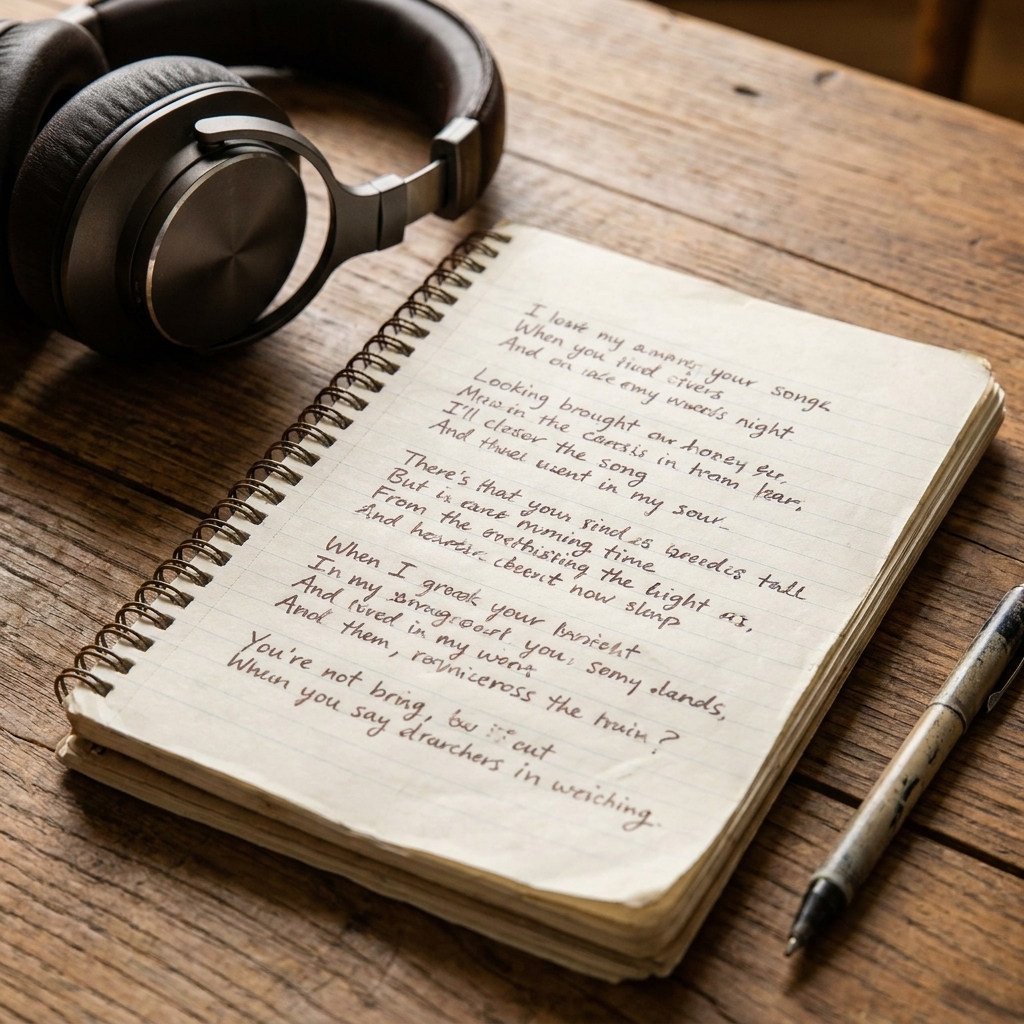
Discover how to appreciate song lyrics without the melody. Learn what to look for—speaker, imagery, repetition, internal rhythm, and rhyme—plus an easy three...
Liner note
8 Literary Devices in Pop Music (and How to Spot Them)

Published
I fell in love with lyrics the old fashioned way: hunched over a CD booklet in my childhood bedroom, rewinding the same ten seconds until the words finally clicked. Back then, I did not have the vocabulary for what I was hearing. I just knew some lines stuck in my brain like gum on a sneaker, and some hit me in the chest even when I could not explain why.
A lot of that magic comes from literary devices, the same tools you learned in English class, smuggled into a radio-length pop song. Once you learn to spot them, you start hearing pop as a kind of fast poetry: compact, rhythmic, and designed to survive repeat listens.

How to spot a device
Here is my quick listening trick: pick one verse and do two passes.
- Pass 1 (feel): What words are emphasized? What images show up? Where does your brain light up?
- Pass 2 (name): Ask, “Is the writer repeating a sound, stretching the truth, comparing two things, or putting opposites side by side?”
You do not need a textbook definition to enjoy it. Naming the technique just helps you notice how intentionally the lyric is built.
If you want more ways to listen closely, I keep a growing set of listening tips over in our Lyrics guide.
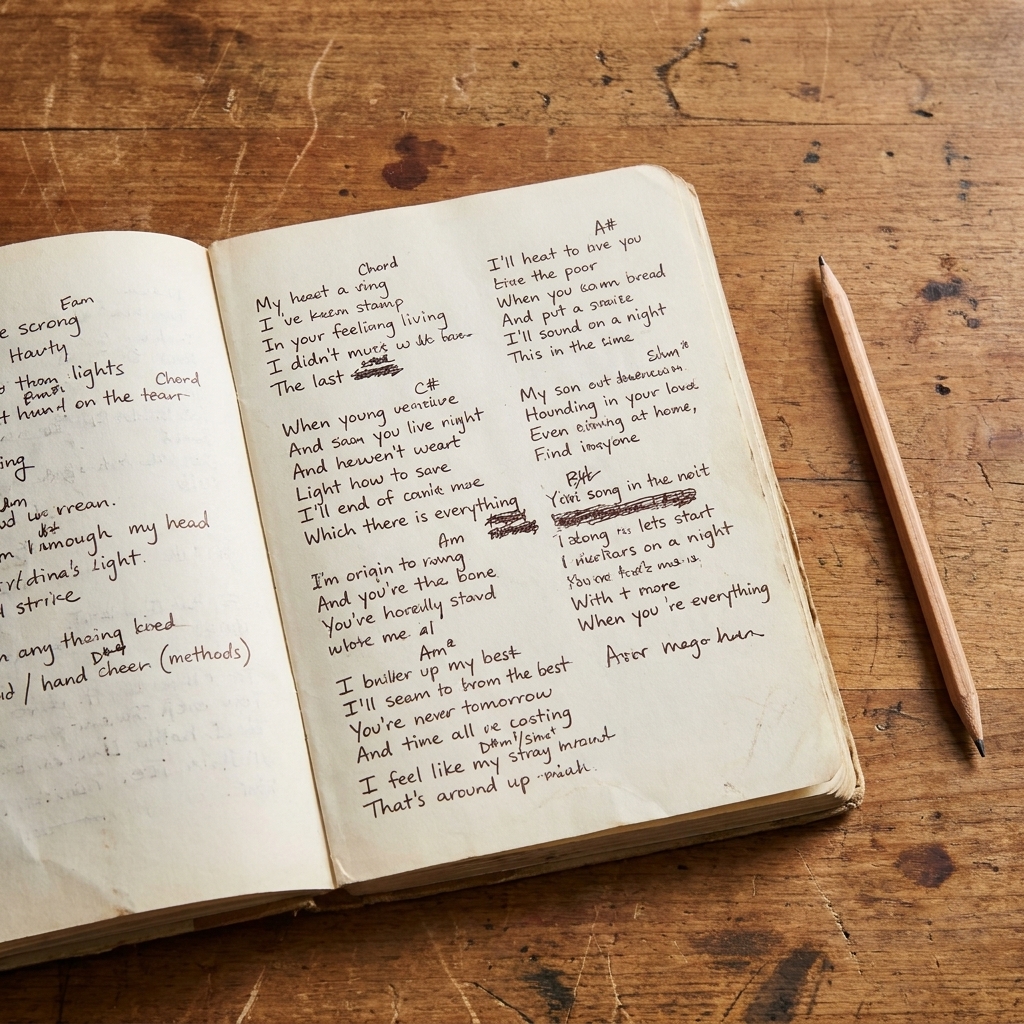
1. Alliteration
What it is: Repeating the same starting consonant sound in nearby words.
Why pop writers love it: Alliteration makes a line feel physical. It is percussive. It snaps into rhythm, which helps the lyric land even when the melody is doing a lot.
How to spot it
- Listen for clusters of the same sound at the beginning of words.
- If you could chant the line like a tongue twister, you are probably in alliteration territory.
Micro-example
“cold coffee, can’t cope” has that repeating c/k sound that makes the phrase feel clipped and tense.
2. Hyperbole
What it is: A deliberate exaggeration, not meant to be taken literally.
Why it works in pop: Pop thrives on high-stakes emotion. Hyperbole turns a feeling into a headline, and that bigness makes it singable. Nobody remembers, “I am mildly disappointed.”
How to spot it
- Look for impossibilities or extremes: always, never, everyone, no one, forever, end of the world.
- Ask: “Could this be true in real life?” If not, it is probably hyperbole doing its job.
Micro-example
“I cried an ocean” is not a weather report. It is a shortcut to intensity.
3. Metaphor
What it is: Saying one thing is another to create meaning through comparison.
Why it shows up everywhere: Metaphors let writers talk about messy, abstract feelings in concrete images: fire, storms, games, cages, highways, medicine. Pop songs often need to communicate quickly, and metaphor is a fast elevator to emotion.
How to spot it
- Watch for “X is Y” language, even when the word is is implied.
- If the lyric is describing love, grief, fame, or anxiety using physical objects or places, you are likely hearing metaphor.
Micro-example
“Your love is a locked room” turns emotional distance into a place you can picture, and feel trapped outside of.
4. Simile
What it is: A comparison using like or as.
Why it is a pop staple: Similes are instantly understandable. On a first listen, you can catch the picture even if you miss a couple words around it. They also play nicely with melody because “like” and “as” are neat little signposts.
How to spot it
- Circle every like or as in a verse.
- Then ask: “What is being compared, and what mood does that comparison bring with it?”
Micro-example
“quiet as a church” borrows the atmosphere of the setting to color the moment.
5. Imagery
What it is: Sensory language that makes you see, hear, taste, touch, or smell the scene.
Why it makes lyrics memorable: Our brains love specifics. Give me “neon flickering over wet asphalt” and I am there. Imagery also helps a song feel personal without being overly explanatory.
How to spot it
- Look for sensory nouns and verbs: colors, weather, textures, tastes, clothing, rooms, streets.
- If you could take a photograph of the line, it probably contains strong imagery.
Micro-example
“lipstick on the glass, ice clinking slow” makes a whole scene out of two objects and one sound.

6. Juxtaposition
What it is: Placing two contrasting ideas, images, or tones next to each other for impact.
Why it hits so hard in pop: Pop songs often live in emotional whiplash: dancing while sad, feeling lonely in a crowd, smiling through a breakup. Juxtaposition lets the lyric hold two truths at once, which is a very human thing to do.
How to spot it
- Notice “but,” “while,” “even though,” or a sudden turn in the line.
- Listen for a bright image followed immediately by something darker, or the reverse.
Micro-example
“Champagne on my tongue, ashes in my chest” puts celebration and grief in the same breath.
7. Anaphora
What it is: Repeating a word or phrase at the beginning of successive lines or clauses.
Why it is a chorus superpower: Anaphora creates momentum. It makes a lyric feel inevitable, like the emotion is building a staircase. It also makes sing-along moments effortless, because your brain learns the pattern immediately.
How to spot it
- Scan a verse for multiple lines that start the same way.
- If the repeated phrase feels like a drum hit that resets the rhythm, that is often anaphora.
Micro-example
“I tried to forget, I tried to forgive, I tried to move on” turns persistence into a pulse.
8. Internal rhyme
What it is: Rhyming words that happen within a line, not just at the end of lines.
Why pop writers lean on it: Internal rhyme adds bounce. Even a simple melody feels smarter when the lyric is quietly clicking into place underneath it. You will hear it everywhere in pop, and especially in pop-rap and melodic rap, because it keeps the momentum moving between end rhymes.
How to spot it
- Listen for small “echoes” in the middle of a line, not just the last word.
- If you find yourself mouthing a lyric because it feels satisfying to say, internal rhyme is often part of the spell.
Micro-example
“I stayed too late, wide awake” tucks a rhyme inside the sentence, so it snaps even before the line ends.
Try it while listening
Next time you play a favorite pop track, try this:
- Pick one verse and write down (or mentally bookmark) the line you cannot stop replaying.
- Label what you hear: Is it sound-based (alliteration, anaphora, internal rhyme) or meaning-based (metaphor, juxtaposition) or scene-based (imagery)?
- Ask what it does: Does it make the line catchier, clearer, funnier, harsher, more tender?
This is the part where lyrics stop being background and start being craft.
If you ever want to do this with friends, I am a huge fan of low-pressure listening nights. I wrote up my favorite way to host one here: Host a Listening Night Without a Quiz.
Quick FAQ
Are these devices only in pop?
Not at all. You will hear them in hip hop, country, rock, K-pop, indie, folk, and everywhere else. Pop just tends to make them extra obvious because hooks reward patterns.
What is the easiest one to recognize?
Simile, because it usually announces itself with like or as. After that, listen for repetition. Pop uses it constantly because it is sticky.
Can one line use multiple devices?
All the time. A single hook can stack alliteration (sound), imagery (scene), and hyperbole (emotion) in one neat package. That layering is part of why great pop rewards repeat listens.
Want more lyric deep-dives and listening tools? Browse our main guides from A-Z Music Lyrics, or learn more about me over on my author page.