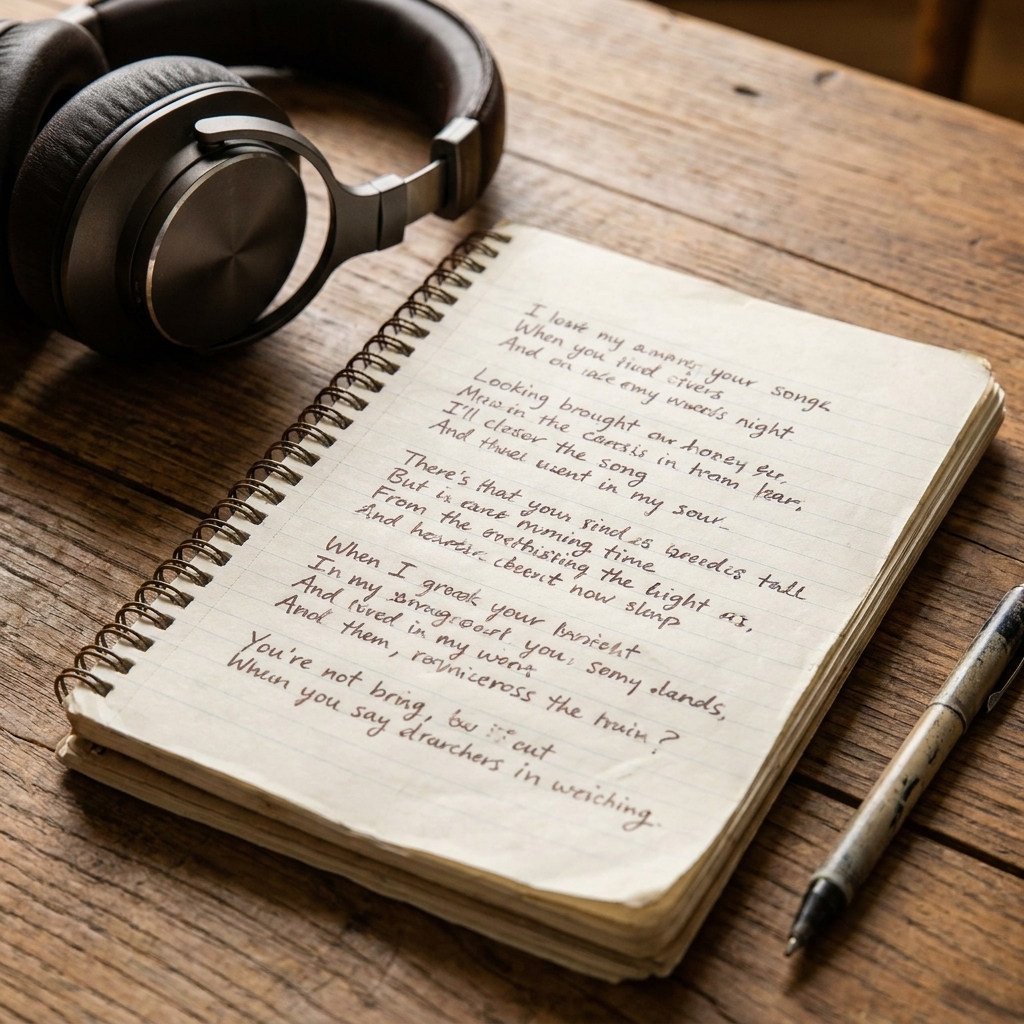

Read lyrics like a critic with a simple 10-step framework: identify the speaker, map structure, track repetition and imagery, translate metaphors, name theme...
Liner note
Verse, Chorus, Bridge: Where the Story Hides

Published
I used to treat song structure like a map I did not really need. Verse, chorus, verse, chorus, bridge, chorus. Sure. Then I started actually following the lyrics with my finger the way I did as a kid with CD liner notes, and I realized something: placement is part of the meaning.
The same line can feel like a confession in a verse, a manifesto in a chorus, or a rupture in a bridge. Songwriters know that. They are not just choosing words. They are choosing when those words arrive, how often we hear them, and what emotional gravity they carry.

Structure is timing
If you have ever wondered why a chorus sometimes feels like the whole point of a song, it is because choruses are made to be revisited. Verses, on the other hand, often push the story forward. Bridges often interrupt the pattern on purpose, even if that interruption is subtle.
That is the simplest way I can put it:
- Verses usually answer: What is happening? Where are we? What changed?
- Choruses usually answer: What does this mean to me? What am I stuck on?
- Bridges usually answer: What have I been avoiding? What is the twist, doubt, or escalation?
When you listen like this, structure stops being “the order of parts” and becomes storycraft.
If you want a broader toolkit for this kind of listening, I keep a running set of techniques in Analyze Song Lyrics Like a Literary Critic.
Verses: the camera work
Verses are where the song earns its specificity. This is the part that tends to change each time, which makes it perfect for narrative motion: new details, new scenes, new information.
What verses do best
- Set the scene: names, places, weather, time of day, the tiny objects that make a song feel lived in.
- Move the plot: the “then what happened” energy.
- Build character: not only who “I” is, but who they become when pressure hits.
- Earn the chorus: the chorus lands harder when the verse has made the stakes real.
A placement trick writers use
Many writers start verse one wide, then zoom in:
- Verse 1: establishing shot (who, where, what vibe)
- Verse 2: complication (the problem sharpens)
- Verse 3 (if it exists): consequence (we see the cost), or sometimes the story detours into a bridge instead
Even in non-literal songs, that “zoom” can be emotional rather than factual. The lyrics become less about describing and more about admitting.

Choruses: the line you cannot unhear
The chorus is designed for repetition, and repetition is power. It can turn a fleeting thought into a belief. It can make a private feeling sound communal. It can also trap a narrator inside the same loop, which is a story choice as much as a musical one.
What choruses do best
- State the central idea: the line you would write on the front of the album booklet.
- Deliver an emotional peak: even if the words are simple, the placement makes them feel inevitable.
- Create contrast: a bright chorus after a tense verse, or a bleak chorus after an upbeat scene, can create emotional irony.
- Act like a refrain: each return carries new meaning because the verses changed what we know.
The same words, different meaning
Here is a tiny, concrete example I use when I am teaching myself to listen harder:
- First chorus: a line like “I’m fine” can land as bravado, a practiced smile.
- Second chorus: after another verse adds context, “I’m fine” can read as denial.
- Final chorus: after the bridge cracks something open, “I’m fine” can sound like surrender, or like a choice.
That is narrative placement at work. The chorus is repeated, and it is reframed.
Bridges: the emotional twist
I am a bridge evangelist. Maybe it is because in real life, the things we avoid saying tend to surface all at once. A good bridge feels like that: a sudden door opening.
In many verse-chorus pop songs, the bridge arrives after we have lived with the chorus enough times that it starts to feel like the song’s truth. The bridge’s job is to challenge that truth, complicate it, or deepen it. In other styles, the “bridge moment” might show up as a beat switch, a featured verse, a breakdown, or a sudden change in point of view.
What bridges do best
- Shift perspective: “I” becomes “you,” present becomes past, confidence becomes doubt.
- Raise the stakes: the bridge can reveal what the narrator is really risking.
- Introduce the missing piece: a new image or confession that recontextualizes everything.
- Change the emotional temperature: calmer, louder, emptier, more frantic. The lyrics often follow that shift.
Common bridge moves
- The question: a sudden “what if” cracks open ambiguity.
- The apology or vow: a bridge can be where accountability finally shows up.
- The time jump: future tense can turn a love song into a regret song in four lines.
- The self-contradiction: admitting the chorus might be a lie is a fast way to make a song feel human.

How sections share the weight
One of my favorite listening exercises is to ask: Where is the emotionally heaviest line placed? Writers can “weight” different sections by giving them different kinds of language.
Common patterns
- Verse heavy: the most devastating line is a throwaway detail in verse two. This often feels intimate, like reading someone’s journal.
- Chorus heavy: the biggest feeling is repeated, which makes the song feel like a public declaration.
- Bridge heavy: the truth is withheld until the breaking point, which makes the end hit like a reveal.
Watch the handoff
Great songs often hand off emotion from section to section:
- The verse gives you evidence.
- The chorus gives you interpretation.
- The bridge gives you consequence, or a new lens.
That is narrative, not just structure.
Beyond the basics
Not every song is verse-chorus-bridge in the classic sense, and a lot of modern pop plays with extra hinges. These are worth listening for because they often carry the sneakiest story beats.
It is also worth saying plainly: some songs lean on AABA, some are through-composed, and some live in rap and R&B forms where “verse” and “hook” behave differently than rock radio trained us to expect. The placement question still works, though. You are still asking: what repeats, what changes, and what arrives last.
Pre-chorus
The pre-chorus is where anticipation lives. Lyrically, it often does one of two things: it narrows the focus (less scenery, more heartbeat), or it sets up the chorus punchline by raising a question the chorus answers.
Post-chorus
Post-choruses can be wordless, repetitive, or built around a short lyrical tag. If the chorus is “what I mean,” the post-chorus is often “what I cannot stop feeling,” even when the words are minimal.
Outro
Outros are underrated narrators. Repeating the chorus as the music fades can feel like being stuck. Changing one word in the final line can feel like growth. Ending on a verse-like detail can feel like the camera pulling back to show the aftermath.
A quick listening method
When I am hosting a listening night in my local scene, I like giving people a simple prompt that does not require music theory. It keeps everyone engaged, even the folks who swear they are “not lyric people.”
- Underline the chorus idea: what is the repeated statement or repeated feeling?
- List what changes in each verse: new facts, new images, new emotions.
- Circle the bridge turn: where does the song contradict itself, confess, or shift time?
- Ask what the final chorus means now: did the song earn it, undermine it, or transform it?
If you like that kind of communal listening setup, you might enjoy Host a Listening Night Without a Quiz. It is very much my comfort zone: friends, a playlist, and the kind of questions that make a song feel brand new.
FAQ
Can a chorus advance the story?
Absolutely. A chorus can advance plot if the repeated lines change context because the verses changed what we understand. The words stay the same, but the listener’s knowledge moves forward, and that is still narrative motion.
Why do some songs skip the bridge?
Sometimes the song is designed to feel like a loop, and a bridge would resolve the tension too neatly. Other times the chorus is doing the job a bridge might do, especially in shorter tracks where momentum matters more than a detour.
What if the verses repeat too?
Repeated verses often signal obsession, routine, or being stuck in the same day emotionally. If a writer repeats a verse on purpose, they are often telling you: this character is not learning yet.
Is the hook always the chorus?
No. Hooks can live anywhere: a one-line pre-chorus, a post-chorus chant, even a verse opener. But wherever the hook lives, it is usually placed where the song wants your brain to return, over and over.
Placement is character
Here is what I keep coming back to, after all these years of scribbling lyrics in margins and talking to everyday songwriters after sets: structure reveals how a narrator copes.
- If the hardest truth is hidden in a verse, the narrator might be private.
- If it is shouted in a chorus, the narrator might be convincing themselves.
- If it finally spills in the bridge, the narrator might have been holding their breath the whole time.
So the next time you love a line, ask yourself not only “what does it mean,” but “why did they put it there?” That question alone can turn a familiar track into a story you have never fully heard.
More lyric deep-dives live in our Lyrics guide, and if you want to know who you are reading, you can find me at Stella Conway.