Discover how to appreciate song lyrics without the melody. Learn what to look for—speaker, imagery, repetition, internal rhythm, and rhyme—plus an easy three...
Liner note
Analyze Song Lyrics Like a Literary Critic

Published · Last updated
I fell in love with lyrics the way a lot of kids fall in love with secrets: alone in my bedroom, CD case cracked open, squinting at folded liner notes like they were tiny sacred texts. I was trying to get every word right, sure, but I was also chasing that feeling of, “Wait, what does that mean?”
That question is basically the doorway into literary criticism. The good news is you do not need a degree or a fancy vocabulary to do it. You just need a method. Here’s mine, built for beginners and meant to be used on any song, from a chart-topper to the local opener you saw last weekend.

What it means to read lyrics like a critic
Literary critics do not “decode” a text the way you crack a safe. They build an interpretation that can be supported by evidence from the text itself.
So when you analyze lyrics, you are doing three things:
- Noticing specific choices (wording, images, rhyme, structure).
- Naming what those choices do (create tension, show character, shift time, hide a confession).
- Arguing for a meaning using lines from the song as proof.
If you want a deeper foundation on lyric basics before you dive in, our Lyrics guide is a great companion read.
The 10-step framework
Think of this as a loop, not a ladder. You can jump around. But if you do all ten steps, you will almost always end up with a solid, defensible take.
1) Listen once without reading
On your first pass, let the music steer. Ask:
- What emotion hits first?
- Does the singer sound sure, fragile, amused, furious?
- Where does the song tighten or relax?
This matters because tone is meaning. A line that reads sweet can land sinister when sung with a clipped edge.
2) Read the lyrics like a poem
Now separate the words from the performance. Read them slowly. If you can, read them out loud. Pay attention to punctuation implied by the phrasing. Notice where a sentence breaks across lines, because that is often where tension lives.
3) Identify the speaker (and do not assume it is the artist)
This is the biggest beginner mistake, and it is also the easiest upgrade you can make.
- Speaker: the “I” in the song.
- Artist: the real person performing or writing.
Ask: What kind of person is speaking? How old do they feel? Confident or defensive? Are they telling the truth, or trying to convince themselves?
4) Map the situation in one sentence
Try this prompt: “In this song, someone is ___ because ___.”
Examples (generic on purpose):
- “Someone is leaving because staying would ruin them.”
- “Someone is bragging because they are scared.”
This one sentence becomes your anchor when the imagery gets wild.
5) Track the structure and the turn
Structure is not just musical. It is narrative. In a lot of pop, rock, and country songs, these patterns show up:
- Verses often add details, scenes, or evidence.
- Chorus often states the thesis, obsession, or emotional truth.
- Bridge often flips the perspective, raises the stakes, or reveals the real wound.
But plenty of songs bend the blueprint. You might be listening to rap verses plus a hook, a folk ballad with a repeating refrain, a track with a pre-chorus or post-chorus, or something that never “bridges” at all.
Your job is simpler than labeling. Ask: What repeats, what changes, and where does the meaning shift? And then: What changes after the shift? Does the chorus or hook mean something different by the end?
6) Circle repeated words and phrases
Repetition is emphasis, but it can also be avoidance. If the speaker repeats one phrase like a mantra, they might be trying to make it true.
Quick trick: write the chorus (or the hook, or the refrain) on its own line. Underline the one word that carries the most weight. That is usually the song’s emotional engine.
7) List the imagery
Imagery is where songs become physical. Make a list of concrete items and sensory cues:
- Places: kitchens, highways, motel rooms, back seats
- Objects: rings, receipts, keys, cigarettes, photographs
- Weather and light: neon, winter, sunrise, storm
Then ask: Why these details? What mood do they create? What do they imply about class, region, memory, or intimacy?

How to unpack metaphors
Metaphor is simply one thing described as another. The point is not to guess the “right” answer. The point is to find the emotional logic.
8) Translate the figurative lines
Step A: Name the literal scene. Before you interpret, state what is literally happening. If the lyric says a door closes, a door closes. If the lyric says the speaker is driving, they are driving. Start there.
Step B: Ask what the image does emotionally.
- Does it make the speaker look powerful or small?
- Does it add danger, tenderness, shame, nostalgia?
- Does it speed time up, slow it down, freeze it?
Step C: Translate the metaphor into plain speech. Try: “When they say X, they might mean Y.” Keep it simple. If your translation needs three paragraphs to work, it is probably not the strongest reading.
Step D: Check it against the rest of the song. A good interpretation makes other lines clearer, not fuzzier. If your metaphor theory forces you to ignore half the song, revise it.
Common metaphor patterns
- Weather for mood (storms as conflict, heat as desire, winter as distance).
- Travel for change (roads as freedom, trains as inevitability, planes as escape).
- Homes and rooms for relationships (doors, walls, beds, kitchens).
- Water for memory and overwhelm (drowning, tides, rivers, rain).
Theme and craft
9) Name the theme without flattening it
Theme is the song’s recurring question, not a moral slogan. Many songs hold two themes at once, especially if the speaker is conflicted.
Three prompts that get you there fast:
- What does the speaker want? (love, control, forgiveness, distance, a second chance)
- What is stopping them? (pride, timing, addiction, fear, history, society)
- What do they learn, admit, or refuse to admit?
Topic is what the song is “about” on the surface (a breakup, a party, a hometown). Theme is the human pattern underneath (abandonment, belonging, self-deception, survival).
10) Use sound as evidence
If you want to sound like a literary critic without sounding pretentious, talk about craft. Craft is observable.
Rhyme and near-rhyme. Perfect rhymes can feel resolved. Slant rhymes can feel itchy, unfinished, or realistic. These are not laws, just useful clues. If the song keeps dodging a perfect rhyme, ask why the speaker cannot “land” emotionally.
Rhythm and line length. Short lines can feel like certainty or panic. Long lines can feel like storytelling, rambling, or spiraling.
Melody and emphasis. Notice which word gets the highest note, the longest held syllable, or the sharpest accent. That is often where the song tells the truth, even if the lyric pretends otherwise.
A tiny worked example
Here is a made-up mini lyric so you can see the method in motion:
“Your coat still hangs behind the door
Like the house forgot to move on
I tell my friends I’m fine, of course
Then practice laughing when they’re gone.”
- Speaker: someone recently left, trying to appear steady.
- Situation in one sentence: someone is performing “okay” because admitting grief feels too raw.
- Repetition idea (implied): “I’m fine” is a script, not a fact.
- Imagery: coat, door, house. Domestic objects that keep the absence in the room.
- Metaphor translation: “the house forgot to move on” might mean the space still holds the relationship, even if the speaker tries not to.
- Sound and delivery (what to listen for): if “fine” is sung too brightly or too quickly, the performance becomes part of the point.
You do not need to be grand about it. You just need to connect the dots you can actually point to.
Context without conspiracy
Background can enrich your reading, but it should not replace it.
Useful context
- When the song was released (and what the artist was making around that time).
- The genre’s conventions (what counts as “normal” imagery or storytelling).
- Real historical references clearly named in the lyrics.
Context that can trap you
- Assuming every line is autobiography.
- Forcing a theory based on one interview quote.
- Treating internet “confirmed meanings” as the only meaning.
If you enjoy the culture side of lyric interpretation, our Pop Culture guide is a fun way to connect songs to the world they are living in.
My annotation method
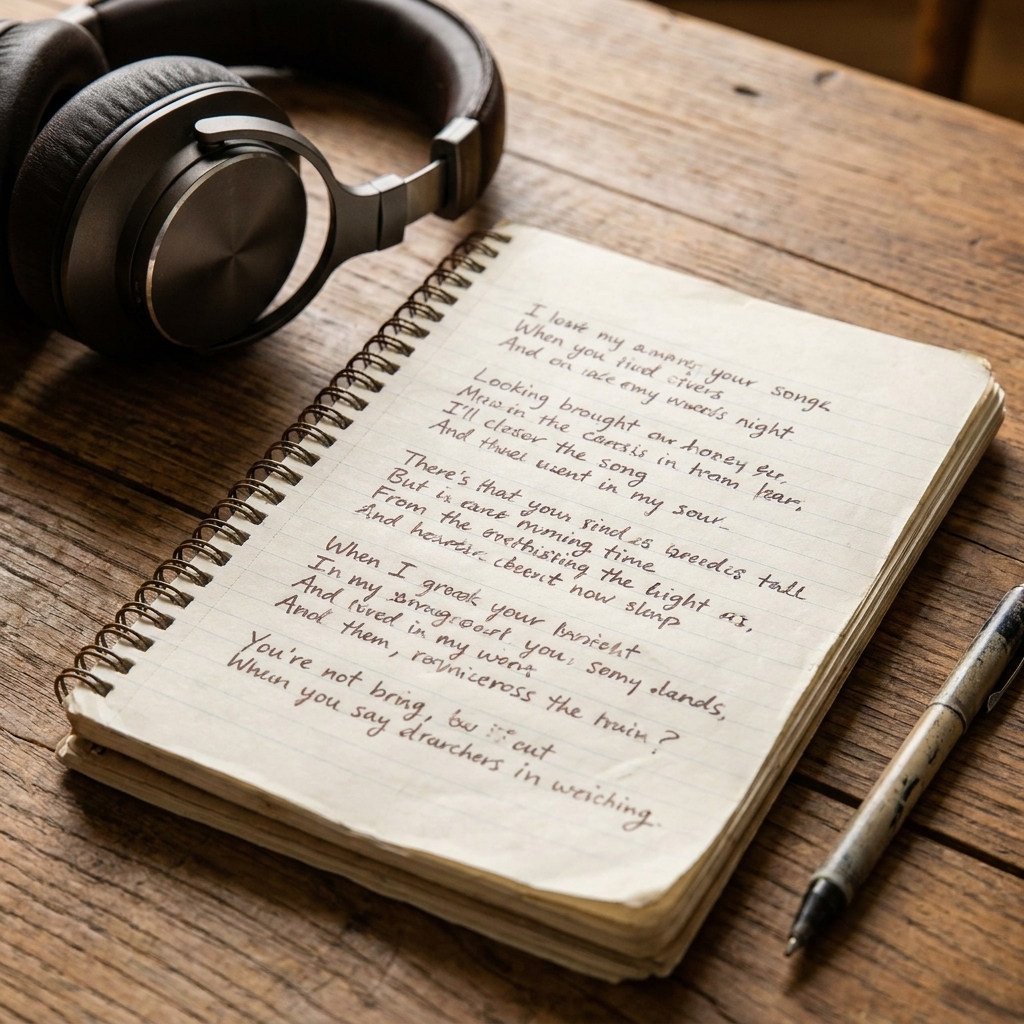
When I am listening with friends at a community acoustic night, I keep my notes ridiculously simple. Here is the system:
- Underline the line that feels like the thesis.
- Circle repeated phrases.
- Box images or objects that recur.
- Write in the margin one emotion per verse (jealousy, relief, dread, hope).
- Star the moment the song shifts, even slightly.
By the end, you can usually say: “This speaker keeps returning to this image because they cannot say this feeling directly.” That is criticism.

Mini checklist
If you want to write a tight paragraph about a song, use this checklist.
- Claim: What do you think the song is really doing?
- Evidence: Quote two to four short lyric moments that support your claim.
- Technique: Name at least one craft choice (metaphor, repetition, contrast, perspective shift).
- Effect: Explain what that choice makes the listener feel or realize.
- Complication: Mention one line that adds ambiguity and say why it matters.
Common beginner mistakes
- Mistake: Trying to interpret every line.
Fix: Focus on the lines that repeat, change, or feel unusually specific. - Mistake: Treating metaphors like puzzles with one solution.
Fix: Offer one main reading and one alternate reading, then pick the stronger one using evidence. - Mistake: Ignoring the chorus because it is “just repeated.”
Fix: The chorus or hook is often the argument. Ask why it has to be said again. - Mistake: Forgetting the music exists.
Fix: Note where the vocal delivery softens, cracks, snaps, or stretches a word.
Try it tonight
A 15-minute lyric deep listen
- Pick one song you love but have never read.
- Listen once without lyrics. Write three adjectives for the mood.
- Read the lyrics once. Underline one line that feels like the core.
- Listen again and circle what repeats.
- Write one sentence: “This song is about ___, but it is really about ___.”
If you want to turn this into a small-group ritual, I wrote up my favorite low-pressure format here: Host a listening night without a quiz.
FAQ
Can a song have more than one meaning?
Absolutely. Many great songs are built to hold multiple readings. Your job is not to narrow it to one “correct” answer. Your job is to explain why your reading fits the words, structure, and tone.
What if I do not relate to the story?
You can still analyze it. Treat it like a short story told by a narrator who is not you. Focus on character, stakes, and the specific details that make the world feel real.
How do I quote lyrics when writing about them?
Quote short excerpts rather than reproducing large sections. Use the quote as evidence, then explain what the wording is doing. If you want more general guidance, start with our Lyrics guide and build from there.
What is the fastest way to get better?
Analyze the same song twice, a week apart. The first read is instinct. The second read is craft. You will start noticing patterns like internal rhyme, perspective shifts, and how one object quietly carries the whole emotional plot.
Keep it curious
My favorite part of lyric analysis is that it never fully ends. A line you thought you understood at sixteen will crack open again at thirty. That is not you being inconsistent. That is the song meeting a new version of you.
If you ever want to share an interpretation or pitch a song you think deserves a close read, you can find me through my author page or reach out via the site contact page.