Read lyrics like a critic with a simple 10-step framework: identify the speaker, map structure, track repetition and imagery, translate metaphors, name theme...
Liner note
Reading Lyrics as Poetry

Published
I fell in love with lyrics the old fashioned way, alone in my childhood bedroom, hunched over a CD booklet like it was a secret diary. No melody in that moment, just black ink on thin paper and the strange little thrill of realizing: these words can stand on their own.
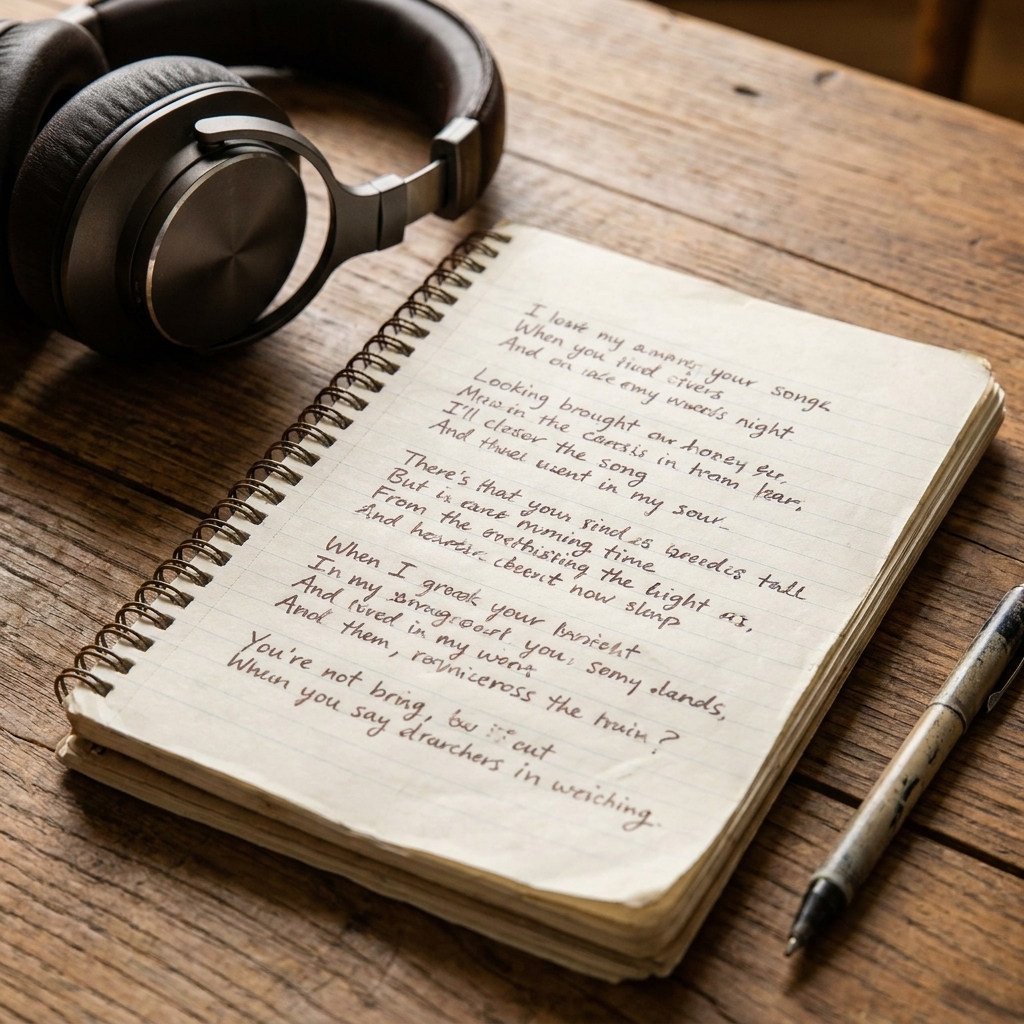
Reading lyrics as poetry is not about proving a songwriter is a poet, or stripping away the “real” experience of the song. It is about changing the lighting. When you remove the music, the words stop riding the wave of melody and you can finally see their bones: the images, the turns of phrase, the pacing, the silences.
Why lyrics feel different on the page
Melody is persuasive. A gorgeous chord change can make a simple line feel profound, and a heartbreakingly delivered note can smooth over a clunky phrase. When you read lyrics without music, you lose:
- Vocal emotion (the crack in a voice, the laugh on a consonant, the breath before a confession)
- Rhythmic guidance (where the stress lands, how long a thought is held)
- Production cues (a drum fill that signals urgency, a synth swell that signals wonder)
But you gain something too: you can ask what the words are doing by themselves. What are they saying literally? What are they implying? Where do they speed up, repeat, contradict themselves, or dodge the truth?
Set yourself up to read, not listen
When I host community acoustic nights, I sometimes ask people to do a “silent first read” of a lyric sheet. It feels awkward for about ten seconds, then it becomes oddly intimate.
Try this quick setup
- Change the format. If you can, put the lyrics in a plain notes app or print them. Removing album art and playback buttons helps your brain stop anticipating sound.
- Read once straight through. No analysis yet. Just let the speaker talk at you.
- Read a second time out loud. You will hear where your mouth wants to rush, pause, or emphasize. That is the lyric’s hidden rhythm showing itself.
- Mark what you feel. Underline lines that hit you, circle words that feel loaded, and star any image you can actually picture.
If you want a broader warm-up on lyric meaning, our Lyrics guide is a good jumping-off point before you go full poetry-nerd.
What to look for when the melody is gone
Poetry reading is basically learning where to point your attention. Here are the elements that tend to jump out once the music is no longer carrying the emotion for you.
1) The speaker and the point of view
Ask: who is talking, and to whom?
- First person often feels confessional, but it can also be performative or unreliable.
- Second person can be tender, accusatory, or manipulative, sometimes all within one verse.
- Third person can create distance, like someone reporting a scene they cannot emotionally enter.
On the page, you also notice pronoun drift. A lyric that slides from “I” to “we” to “you” might be showing a relationship changing in real time.
2) Imagery that does the emotional work
When the chorus is not soaring, the metaphors have to earn their keep. Look for:
- Concrete objects (keys, kitchen tiles, train stations) that act like emotional anchors
- Sense language (taste, texture, temperature) that makes the scene feel lived in
- Color and light words that subtly steer mood
A quick test: if you had to stage this lyric as a silent film scene, what props would you need? The better the lyric, the clearer your list becomes.
3) Repetition and what it reveals
In songs, repetition can be purely musical. On the page, repetition reads like insistence, spiraling, prayer, or denial.
- Is the repeated line identical, or does one word change each time?
- Does repetition feel like conviction or self persuasion?
- Does the chorus answer the verse, or just echo it?
4) Internal rhythm, even without a beat
Lyrics still have meter-like behavior. You can spot it through:
- Line length (short lines punch, long lines tumble)
- Hard consonants (k, t, p) that create bite
- Soft sounds (s, m, l) that create hush or intimacy
- Enjambment, when a thought spills into the next line and refuses to land neatly
This is where reading out loud pays off. Your tongue becomes the percussion section.
5) Rhyme and near-rhyme
End rhymes are easy to spot, but I get more excited about near-rhymes and internal rhymes because they often carry subtext. Near-rhymes can feel like two ideas almost aligning, or a speaker almost telling the truth.
Look for:
- Slant rhymes (sounds that almost match)
- Internal rhymes hidden mid-line
- Rhyme avoidance, when you expect a rhyme and the writer refuses it, creating tension
How absence changes the emotional impact
Here is the part people do not expect: reading lyrics without music can make them feel more emotional, not less.
It can make joy look simpler
Upbeat music can make a lyric feel celebratory even if the words are plain. On the page, that same chorus might read like a postcard. That is not a failure, it is information. Maybe the song’s joy lives in the groove, not the vocabulary.
It can make heartbreak look harsher
Music can soften pain with beauty. Without it, a blunt line becomes very blunt. Some lyrics are shockingly direct when you read them like diary entries.
It can reveal humor and menace
A playful melody can disguise cruelty, and a gorgeous vocal can disguise a joke. Reading lets you catch tonal whiplash: a sweet phrase that is actually a threat, a romantic image that is actually an exit strategy.
A simple method: the three-pass lyric read
Pass 1: Literal story
Write one sentence: what is happening, literally, on the surface? If it is not narrative, name the situation. Example: “A person is trying to leave a relationship but keeps getting pulled back.”
Pass 2: Emotional argument
Now ask: what is the speaker trying to convince themselves of? Lyrics often function like arguments with the self. Identify the claim and the evidence.
Pass 3: The turn
Most strong lyrics have a pivot. Look for the moment where:
- a new image enters
- a tense shifts
- a pronoun changes
- a detail gets suddenly specific
That turn is where the song often “becomes itself.”
Common traps when reading lyrics like poems
Assuming the singer equals the speaker
Sometimes it is autobiographical. Sometimes it is theater. Reading on the page can tempt you to play detective. Instead, focus on what the speaker is doing in the text.
Overvaluing complexity
Some of the greatest lyric writing is plainspoken. Poetry is not synonymous with ornate vocabulary. It is precision, surprise, and resonance.
Ignoring structure
Verses, choruses, pre-choruses, bridges: these are not just musical containers. They are meaning containers. A bridge often reads like a confession the verse could not say out loud.
Make it social (without turning it into homework)
One of my favorite low-pressure ways to do this is at a listening night, but with a twist: read first, then play the song. People are always startled by how the music edits their interpretation.
If you are curious about hosting something cozy and lyric-forward, I wrote up ideas in How to Host a Listening Night Without a Quiz.
Quick exercises to build your “lyric ear”
- Copy one verse by hand. You will notice patterns you missed when you only glanced at it.
- Replace one key noun. Swap “car” for “train,” “summer” for “winter.” If the line collapses, the original word was doing heavy work.
- Find the strongest image. Identify the single line you would frame on a wall. Ask why that one survives without melody.
- Underline all verbs. Verbs reveal whether a lyric is active (doing) or static (remembering, waiting, wishing).
FAQ
Are lyrics actually poetry?
They can be, but they do not have to be. Lyrics are built to be sung, so they are allowed to rely on repetition, sonic texture, and performance in a way page-poems might not. Reading them as poetry is a tool, not a label.
Why do some lyrics look awkward when written out?
Because the music was carrying part of the meaning. A stretched vowel, a syncopated entrance, or a pause before a word can transform a line. On the page, you are seeing what the melody was flattering.
What if I do not understand a lyric without hearing it?
That is normal. Try reading it out loud, then add your own punctuation marks where you think the breaths belong. You are essentially reconstructing phrasing, which is part of the song’s original design.
The best payoff
When you go back to the recording after reading, the music feels richer, not smaller. You start hearing choices: why that word is whispered, why that line is repeated one more time, why the bridge suddenly stops being vague and gets painfully specific.
And if you find a line that hits harder on the page than it ever did through headphones, keep it. That is the secret gift of reading lyrics as poetry: you get to carry the words with you, even in silence.
If you want more ways to dig into meaning, start with our Lyrics guide, then wander into Music Trivia when you feel like zooming out to the stories behind the songs.