
Liner note
The Producer’s Touch on Lyrical Flow

I used to think “flow” lived entirely in the rapper or singer. Then I started hanging around enough community acoustic nights and home studios to notice a pattern: the moment a producer changes the drum swing, the entire room’s language changes. Suddenly the line that sounded brilliant on paper feels too long, too neat, too early, too late. And the artist, even a great one, starts rewriting with their ears instead of their ego.
That is the producer’s quiet superpower. Beatmakers do not just give a song its mood. They often set the rules of time, or at least the rules everyone agrees to follow for three minutes. Those rules nudge syllables into place, reshape phrasing, and even influence what kinds of words feel “right” in the mouth.
What we mean by “lyrical rhythm” and “phrasing”
Before we blame or praise a producer for a vocal pattern, it helps to name what we are hearing.
- Cadence: the pattern of stressed and unstressed syllables, plus where a phrase lands in the bar.
- Pocket: the sweet spot relative to the drums. Two artists can rap the same words, but one sits behind the snare and one leans ahead of it.
- Subdivision: how the flow divides time. Straight eighths, triplets, sixteenths, halftime, double-time.
- Breath and phrasing: where a vocalist must inhale, how long they can hold a line, and whether the delivery feels conversational or athletic.
If you want the quickest on-ramp to hearing structure, pair this with our guide to verse, chorus, and bridge, because producers often change lyrical rhythm by changing the section’s job.
How producers nudge word placement
Most of the time, nobody says, “Please adjust your syllable density by 12 percent.” Producers communicate through sound. Here are the pressure points that shape lyrical rhythm almost immediately.
1) Drum placement decides where consonants feel satisfying
Consonants are percussion. A crisp t or k can feel amazing when it snaps with the snare. If a producer’s snare is heavy and bright, artists often lean into harder edges: tighter diction, more plosives, punchier end rhymes. If the drums are soft and pillowy, you often hear more legato phrasing, longer vowels, and lines that smear across the beat.
2) Swing and shuffle change the “right” syllable count
One tiny change in swing can make a previously perfect line feel like it is tripping. When hi-hats are swung, syllables that land on off-beats can suddenly feel more natural, and the artist often starts using:
- More internal rhymes (because the groove has more wiggle room).
- Shorter word endings (to avoid sounding stiff).
- More syncopation (because the beat invites it).
A quick micro-example: take a plain, straight delivery like “I can’t believe you did that.” On straight hats, you might hit it evenly, almost marching: I CAN’T | beLIEVE | you DID | THAT. Add swing and the line often wants to “lay back,” so you stretch the vowels and tuck little words into the late spaces: I caaan’t… beLIEVE you… did that, with you and did nudged into the pocket instead of sitting dead-center.
3) BPM and energy determine syllable density
Fast BPM does not always mean fast rapping, but it changes the body’s relationship to breath. Producers can encourage:
- Double-time illusion: drums feel fast, vocal stays mid-tempo, but the hats make it feel urgent.
- Actual density: more syllables per bar, more stacked multis, more run-on phrasing.
- Space: a confident producer can leave gaps that make an artist simplify, repeat, or speak more plainly.
4) The bassline can act like a metronome for vowels
This is my favorite subtle one. A moving bassline often pulls a vocalist toward longer notes and sustained vowels. A bassline that hits in short, percussive bursts tends to invite tighter, more clipped phrases. It is not magic and it is not strictly physiology either. It is part perception, part habit: your ear and mouth tend to mirror the length and weight of what they are hearing.
5) Arrangement tells the lyric what it can get away with
When the track is busy, the vocal usually has to make clearer choices. Producers who stack dense synths and percussion can push the lyric into simpler shapes: fewer words, cleaner rhyme, more repeated motifs. Minimal production often does the opposite. With more empty air, an artist can risk a longer sentence, a strange image, a conversational aside.
6) Melody and harmony shape phrasing too
If the song is sung, producers have another lever: topline. A melody with lots of repeated notes invites rhythmic speech, almost rap-adjacent. A melody that leaps or holds long tones encourages open vowels and fewer consonant clusters. Harmony matters as well. A tense chord change can make a singer hang on a word longer, or choose a simpler word that can sustain without sounding cramped.
In the studio: phrasing in real time
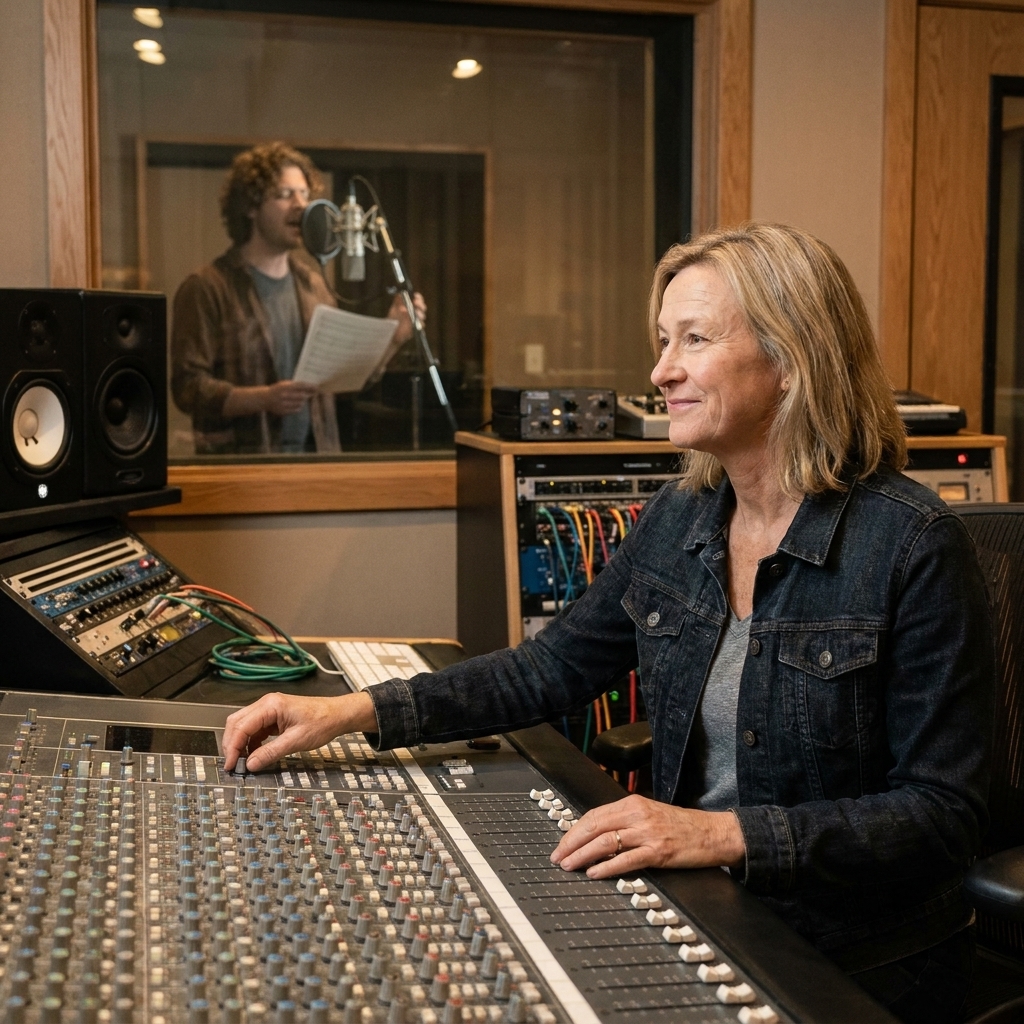
Even when an artist arrives with finished lyrics, the studio is a rewriting machine. Producers and vocal producers guide phrasing with tools that do not look like writing, but absolutely are.
Vocal comping rewards certain rhythms
Comping is stitching together the best moments from multiple takes. Here is the sneaky part: the “best” take is often the one that locks to the groove most cleanly. Over a few rounds of comping, the performance naturally drifts toward the producer’s preferred pocket. The lyric might not change on paper, but the rhythm of the lyric changes.
Punch-ins reshape line endings
Punching in line by line can make artists rewrite phrasing to avoid awkward edits. You get cleaner, more modular bars. Sometimes that creates the modern, hyper-controlled feel. Sometimes it removes the breathy, story-spill momentum of a live take. Neither is better, but you can often hear which method a producer favors by how continuous the phrasing feels.
Ad-libs and doubles change what the main lyric must carry
When a producer builds a chorus out of stacks, doubles, whispers, and call-and-response ad-libs, the lead vocal can simplify. The main line becomes a spine, and the extra layers do the decorating. That changes writing choices: more open vowel endings, more chantable shapes, fewer intricate internal rhymes that would blur when layered.
Producer fingerprints you can hear
Credits matter, but your ears can catch patterns first. Next time a song feels like it changed the way the artist talks, listen for these clues.
Clue A: The hook is rhythm first
Some producers build hooks like drum parts. You will hear:
- Short phrases with strong consonants on the snare.
- Repetition that feels percussive, almost like chanting.
- Vowels chosen for singability more than specificity.
Clue B: Verses answer the instrumental
When the beat leaves intentional gaps, the lyric often becomes responsive, like it is speaking back to the drums. A line ends and a synth replies. A kick pattern stutters and the rapper mirrors it. That conversational back-and-forth is often arranged, or at least refined in production, even when it starts as improvisation.
Clue C: Line length suddenly changes
If an artist who usually writes long, winding sentences starts delivering clipped two or three word bursts, it is often because the beat is built to spotlight negative space. Conversely, if a minimalist lyricist starts stacking dense bars, the producer may be building a treadmill that begs to be outrun.
A simple listening drill
This is the little exercise I do when I want to separate artist style from production gravity. Pick one track and run through these steps:
- Count the drum anchors. Find the snare or clap, then notice if it is straight or swung.
- Hum the flow without words. If you can hum the verse like a drum pattern, the producer likely built a groove that strongly steers phrasing.
- Listen for breath edits. Obvious breath control, chopped phrases, or super-clean ends can indicate a production style that favors tight rhythmic placement.
- Notice what happens at section changes. Does the cadence change when the chorus drops? If yes, arrangement is steering the writing.
If you want to go one level deeper, our piece on spotting co-writer influence pairs nicely here, because producers and co-writers often solve the same problem from different sides.
Why lyric lovers should care
When you hear the producer’s touch, you stop treating flow as a fixed personality trait. You start hearing it as a collaboration between body and beat. That can make you a kinder listener, too. A stiff cadence might be a mismatch with the groove. A suddenly simple hook might be an arrangement decision, not a lack of ideas.
It also opens up a more interesting question than “Who wrote this?” Sometimes the real question is: Who made these words move like that?
If you feel like taking that curiosity further, I love approaching songs the same way I approach poems. Our guide to reading lyrics as poetry is a great companion when you want to talk about rhythm without getting lost in music theory.
Quick FAQ
Do producers actually tell artists how to rap or sing?
Sometimes directly, especially in pop sessions with vocal producers. More often it is indirect: the beat’s swing, drum tone, melody, and arrangement make certain phrasing feel like the cleanest choice. Artists adjust because they want the performance to lock in, and producers may adjust too when an artist arrives with a fully-formed flow.
Can a producer change lyrics, or only delivery?
Both. Delivery changes happen through takes, comping, and arrangement. Lyric changes happen when a producer asks for a tighter pre-chorus, a more chantable hook, or a different vowel shape to match melody and rhythm. Even a small edit like swapping “and I” for “I” can be a producer-driven rhythm fix.
How can I tell if it is the producer or the artist evolving?
Compare multiple songs from the same era with different producers. If the artist’s phrasing shifts dramatically depending on who is behind the boards, you are hearing production gravity. If the shift persists across producers, it is more likely an artist-led evolution. Our guide to tracing lyrical eras is built for exactly this kind of detective work.