
Liner note
Accurate Lyric Translations: Find and Understand Them

I fell in love with lyrics in the most old-school way possible: hunched on my bedroom floor, decoding CD liner notes like they were secret messages. These days, the “mystery” is different. A song hits you hard, but it is in a language you do not speak. You search a translation, and suddenly the chorus reads like an instruction manual.
So let’s talk about how to find lyric translations you can trust, and how to read them like lyrics, not like a grocery list. Because the goal is not just to know what the words “mean.” It is to feel why they matter.

Why lyric translations are hard
Song translations are tough even for fluent speakers because lyrics bend language on purpose. A great translation has to juggle meaning, tone, rhythm, and cultural references. Usually, something gets sacrificed.
- Idioms do not travel well. A phrase that feels normal in one language can sound absurd when translated literally.
- Slang changes fast. A line from 2016 might already read differently in 2026, even to native speakers.
- Pronouns can hide the story. Some languages drop subjects or use gendered phrasing differently than English, which can blur who is doing what to whom.
- Wordplay is often the point. Puns, homophones, and double meanings rarely survive a direct translation.
- Cultural shorthand is everywhere. One food, neighborhood, TV host, or holiday reference can carry a whole emotional universe.
If you keep that in mind, you will stop expecting a single “correct” English version and start looking for the most faithful interpretation.
Where good translations come from
Not all translation sources are equal. Here is how I triage them when I am exploring a song outside my native language.
1) Official sources (best when you can find them)
Official translations are not guaranteed, but when they exist they can be gold. Depending on the artist and market, they might appear in:
- Official music videos or lyric videos with subtitles
- Album booklets, deluxe editions, or liner notes
- Artist or label posts
The upside is intent. The downside is that official subtitles sometimes “smooth” lyrics for broad audiences, especially if a line is controversial or highly regional.
2) Liner notes and lyric booklets (great for context)
If you can locate scans, photos, or quoted excerpts from physical releases, they can confirm what the actual words are, which is step one before translation. This is especially helpful when the internet has multiple versions of the original lyrics floating around.
3) Fan communities and annotated translations (often the most insightful)
Some of the most insightful translations I have read were written by fans who care enough to explain a pun, a meme, or a dialect choice in plain language. Look for translations that include translator notes and alternative meanings, not just a single “final” sentence.
4) Machine translation (useful, but never your last stop)
Tools like Google Translate or DeepL can give you a fast map of the song. But maps are not the hike. Machine translation tends to:
- flatten tone and sarcasm
- miss slang and speech-level nuance
- misread poetic grammar and omitted subjects
I treat machine translation as a first draft that helps me ask better questions.
If you want a method for unpacking what you find once you have a translation in hand, you might enjoy our approach in Analyze Song Lyrics Like a Literary Critic.
Is this translation reliable?
Before you trust a translation, run it through a few simple tests. You do not need to be fluent to spot red flags.
Confirm the original lyrics
- Do multiple sources agree on the original language lyrics? If not, the translation might be “accurately” translating the wrong words.
- Does the song include dialect, ad-libs, or spoken lines? Those are often misheard and miswritten.
Look for human attention
- Are there translator notes? Notes are a good sign. They show the translator noticed ambiguity and made choices consciously.
- Are there alternatives offered? Great translators sometimes say, “This could also mean…” because lyrics can be intentionally slippery.
- Is the tone consistent? If a heartbreak ballad is translated in stiff, formal English, something got lost.
Watch for translation tells
- Overly literal phrasing that no English speaker would naturally write in a song
- Random shifts in tense or point of view
- Odd proper nouns that look like they were guessed, not understood
One of my favorite little tricks is to find two independent translations and compare them line by line. Where they differ is where the meaning is probably nuanced.
Slang, idioms, and nuance
This is the part that makes foreign-language songs so addictive. You are not just translating words, you are translating a world.
Step 1: Mark hinge lines
Every song has a few lines that carry the emotional weight. Identify them first. Often they are:
- the title line
- the final line of the chorus
- the line that changes between choruses
- a repeated phrase that seems simple but feels important
Then spend your effort there instead of trying to perfect every pre-chorus filler line.
Step 2: Treat idioms like metaphors
If an idiom translates to something bizarre, do not force it into literal English. Ask: what is the social meaning? Is it flirtation, dismissal, bravado, grief, teasing?
A reliable translation will either replace the idiom with an English equivalent, or explain it briefly in a note.
Step 3: Notice the register
Many languages signal intimacy, respect, age, or social distance through grammar choices. A translation that ignores register might still be “accurate” but emotionally wrong.
- Is the singer speaking formally or casually?
- Does the lyric switch registers to show anger, flirting, or mockery?
Step 4: Pause on local references
If a translation mentions a place, food, holiday, brand, or celebrity you do not recognize, pause. That one noun can be doing the work of an entire paragraph. A quick search can reveal whether it signals:
- class and neighborhood identity
- nostalgia and childhood
- politics or protest
Step 5: Try a three-layer translation
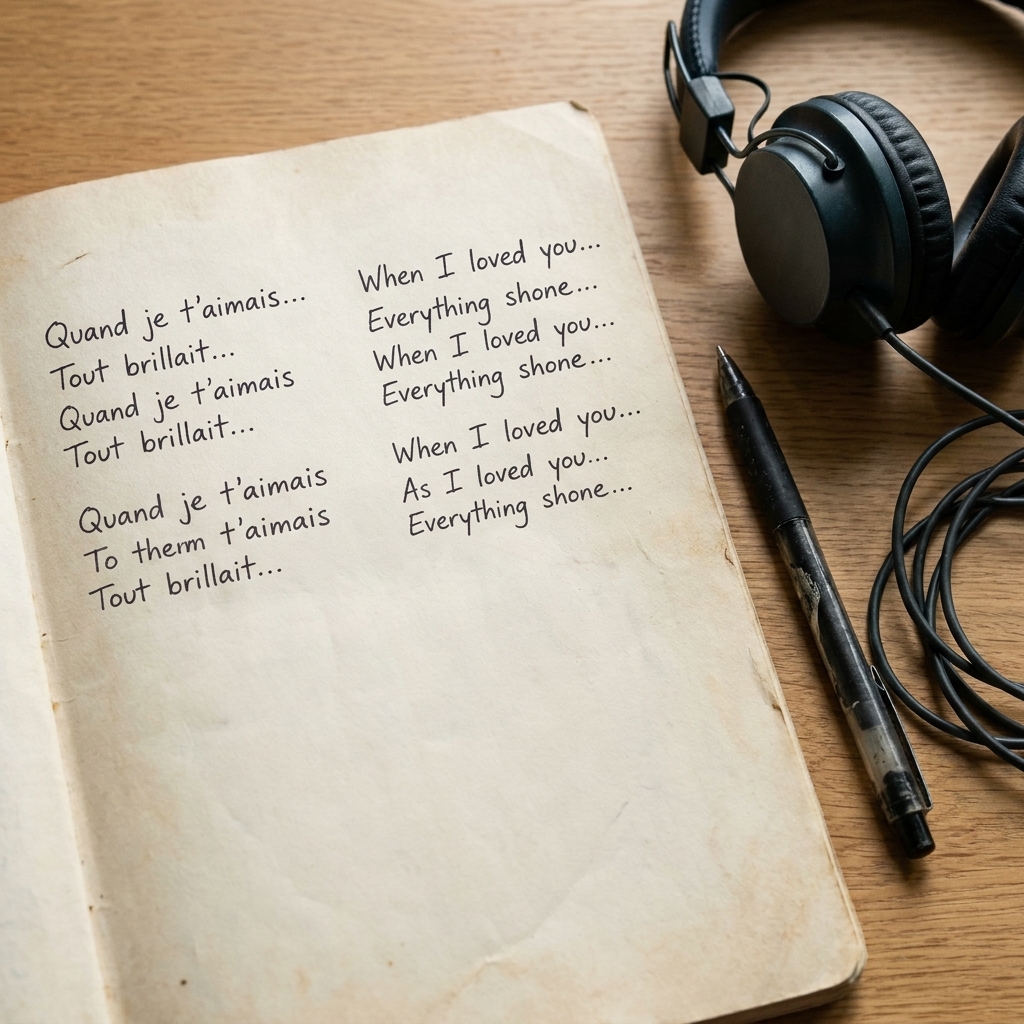
When I really want to understand a song, I write three versions for myself:
- Literal: word-for-word, even if it is ugly.
- Natural: what a fluent speaker would say in English.
- Poetic: the line as a lyric, preserving mood and punch.
You end up with something more honest than a single “correct” line.
Romanization can confuse things
If you are working from romanization or transliteration, be extra cautious. Japanese, Korean, Arabic, and many other languages can be written multiple ways in Latin letters, and those choices can blur or flatten meaning. A romanized line may also hide word boundaries, omit punctuation, or miss a double meaning that is obvious in the original script. When a translation feels weird, it helps to look for the lyric in its native writing system, even if you cannot read it fluently.
Meaning vs singable translations
One more useful distinction: some translations are meant for understanding (subtitles, liner notes, fan annotations), and others are meant to be performed (adaptations that fit rhyme, rhythm, and melody). A singable version can be brilliant and still drift from the literal sense. If your goal is meaning, prioritize translators who explain what they changed and why.
Sanity-check a confusing line
If a translation feels off, here is a low-tech routine that works surprisingly well.
- Listen for repeated sounds. Repetition can signal a pun, a catchphrase, or a word being used in a special way.
- Find the exact line in the original script. Copy it carefully, including punctuation if available.
- Try two machine translators. If they agree, you probably have the basic sense. If they disagree, you have found your nuance.
- Look up one key word in a dictionary that shows usage examples. You are looking for how the word behaves in real sentences.
- Search the phrase in quotes. If it is an idiom or meme, you will often see it repeated elsewhere.
For Japanese, I like dictionaries that show example sentences. For Spanish, you can learn a lot by searching the phrase plus a country name, because slang is intensely regional. For Korean, many lines make more sense once you learn common honorific patterns.
External resources that can be genuinely useful when you are stuck:
- DeepL Translator for alternate machine phrasing
- Google Translate for quick comparison, and it may offer handwriting or audio features depending on your device and region
- WordReference for usage notes and community discussion on tricky Spanish, French, and Italian phrasing
When translations disagree
Disagreement does not always mean one translation is wrong. Sometimes it means the lyric is doing what good lyrics do: holding more than one truth at once.
Match the song’s temperature
If the track sounds tender and the translation reads harsh, or the track sounds playful and the translation reads solemn, question it. Tone is information.
Trust humble translators
A translator who says “could also mean” is often more trustworthy than one who sounds overly confident about every line.
Let the chorus teach you
Choruses repeat for a reason. Once you understand the chorus, verses tend to fall into place because they are usually commenting on the same central idea.
Share translations responsibly
Quick reminder from one lyric nerd to another: lyrics are copyrighted. Translations are often protected too, but the details can vary by country and by rights-holder policy. If you are posting an interpretation online:
- link to the source page when possible
- credit the translator by name if it is provided
- quote small excerpts rather than reposting full lyrics
On A-Z Music Lyrics, we focus on meaning, craft, and context. If you want more on how we approach lyric reading in general, our Lyrics guide is a good place to wander next.
Mini FAQ
Are subtitles on music videos always accurate?
Not always. They are often simplified for readability, and they can diverge from the recorded take or reflect an alternate lyric sheet. They are still worth checking because they can confirm structure and key phrases.
Why do translations make a song sound “cringe” in English?
Because a direct translation usually strips away natural phrasing, rhyme instincts, and cultural shorthand. That does not mean the original is cringe. It means you are seeing the scaffolding.
How can I tell if a translation missed slang?
If the translated line feels strangely formal, or if it uses generic words where the original likely uses something specific, slang is a suspect. Check for regional dictionaries or community discussions of that phrase.
What if I just want to enjoy the song without doing homework?
Totally valid. Even one good translated chorus line can be enough to deepen the experience. You do not have to “solve” a song to feel it.
A listening habit that helps
When I host small listening nights in my local scene, I love putting on one song in a language not everyone knows, then asking one question: What did you feel before you knew what it meant? The answers are always different, and they are always right.
Translation should add layers, not replace your first emotional hit. If you want a low-pressure way to do that with friends, you might like How to Host a Listening Night Without a Quiz.
And if you ever stumble on a translation that completely changes how you hear a song, I hope you keep it. That is the fun part of being a lyric person: we are all trading flashlights in the dark.