
A practical, myth-busting guide to backmasking: what counts as intentional reverse audio, why our brains hear messages, and a step-by-step routine to test cl...
Liner note
Mondegreens Explained

Published
I still remember sitting on my childhood bedroom floor, CD booklet spread open like a treasure map, trying to match every syllable to the singer’s mouth. Even then, I got lines wrong. Not because I was careless, but because my brain was doing what brains do best: making meaning fast, even when the audio is a little blurry.
Those hilarious, stubbornly convincing misheard lyrics have a name: mondegreens. And once you understand why they happen, you can get better at catching the real words without draining the joy out of listening.

What is a mondegreen?
A mondegreen is a misheard lyric where your brain confidently swaps in a different phrase, usually one that sounds similar and feels like it fits. The best ones stick around because they are oddly plausible. You can sing them for years before someone gently (lovingly) ruins your life with the official words.
Mondegreens are not the same thing as simply not knowing the lyrics. The defining feature is that you think you heard something specific. Your brain commits.
Why the name is so weird
The term is credited to writer Sylvia Wright, who described mishearing a line in a Scottish ballad as “and Lady Mondegreen,” when it was actually “and laid him on the green.” The mishearing was vivid enough to become its own little character. That is exactly how mondegreens work: your mind turns fuzzy sound into a picture you can hold.
A few famous examples
If you have ever confidently sung one of these, you already understand the whole concept:
- Jimi Hendrix, “Purple Haze”: “’Scuse me while I kiss this guy” vs “’Scuse me while I kiss the sky.”
- Elton John, “Tiny Dancer”: “Hold me closer, Tony Danza” vs “Hold me closer, tiny dancer.”
- Manfred Mann’s Earth Band, “Blinded by the Light”: “Revved up like a douche” vs “Revved up like a deuce.”
Some of these live on because they are funny, and some because the misheard version honestly makes emotional sense. Both can be true.
Why we mishear lyrics
Mondegreens are not a sign you are “bad at listening.” They are a predictable side effect of how speech perception works, especially when you add music, reverb, and a vocalist who is feeling mysterious.
Your brain predicts
When you listen to speech, you are not decoding sound letter by letter. Your brain constantly predicts what should come next based on context, rhythm, and the words it thinks it already heard. If the signal is unclear, your brain fills the gap with the closest phrase that makes sense to you in that moment.
That is also why you can mishear the same lyric in two different ways depending on your mood, what you expect the song to be about, or even what you are looking at while listening.
Singing blurs word edges
In normal conversation, we use lots of tiny cues to separate words. In singing, those cues get softened by sustained vowels, swallowed consonants, and melodic phrasing. Your brain still tries to segment the stream into words, but it is working with fewer signposts.
Production can hide consonants
Consonants are the crisp edges of language. They are also easy to lose to:
- Reverb and delay, which can smear transients
- Compression, which can reduce contrast between soft and sharp vocal details
- Layered vocals, which can blur syllables together
- Busy arrangements, where cymbals, synths, and guitars can mask upper-mid and high-frequency consonant cues
Sometimes the mix is the point. Dream-pop is not trying to sound like a courtroom transcription.
Your ears and your room count
Car speakers with road noise. Cheap earbuds. A room with hard echo. Even mild hearing fatigue after a long day. All of that nudges your brain toward a “good enough” interpretation, which is prime mondegreen territory.
Patterns that create mondegreens
Not every song is equally mishearing-friendly. A few patterns show up again and again.
Familiar phrases win
Your brain prefers phrases it already knows. That is why mondegreens often turn into common idioms, clichés, or everyday sentences, even when the real lyric is more unusual.
Rhythm steers your guess
English rhythm often emphasizes stressed beats, and melody puts extra weight on certain syllables. If the singer stresses a syllable in a way that feels unexpected for the real words, your brain may swap in a phrase that fits the musical stress better.
Vowels carry, consonants fade
Held notes stretch vowels and soften consonants. If the difference between two phrases mostly lives in the consonants, you are more likely to mishear it.
Accent and tone reshape words
An accent can shift vowel color. A raspy vocal can blur crispness. A breathy delivery can soften the start of a word. None of that is “wrong,” but it changes what cues your ear can grab.

Is it the listener’s fault?
Only in the gentlest sense. We all bring our own vocabulary, expectations, and attention level to a song. If you are half-listening while doing dishes, your brain will still try to resolve the lyric, and it will happily settle for something that fits the vibe.
Also, some words are simply more likely than others. If the sound could plausibly be “lonely” or “only,” your brain may pick the more common option in that lyrical context.
And yes, sometimes the vocalist is intentionally ambiguous. A lot of singers treat diction like another instrument. That is an artistic choice, not a failure of listeners.
Train your ear
I love a good lyric deep-dive, but I also love leaving a little mystery intact. The goal is not to police your listening. The goal is to give yourself options: enjoy the song casually, or zoom in when a line tugs at you.
1) Try a three-pass listen
- Pass one: vibe. Listen straight through, no pausing.
- Pass two: lyric focus.Track the lead vocal rhythm and consonants. Notice where you are guessing.
- Pass three: confirmation. Look up the best available lyrics (more on that below) and listen again, now that you know what to listen for.
This method works because the third pass rewires your perception. Once you know the true lyric, you often cannot un-hear it.
2) Switch playback
Different systems reveal different parts of the vocal. Headphones can highlight breath and articulation. A small phone speaker can exaggerate the midrange, where a lot of intelligibility lives. Switching can interrupt your brain’s autocomplete.
3) Adjust volume on purpose
Try slightly lower volume first. Sometimes that reduces the “wall of sound” effect and makes the vocal easier to parse. If that makes consonants disappear, go back to a comfortable moderate volume and reduce background noise instead. The goal is clarity, not loudness.
4) Hear consonants like percussion
This is my favorite trick. Pretend the vocalist is playing a tiny drum kit made of T’s, K’s, P’s, and S’s. Where are the crisp hits? Where do they vanish?
If you can catch the consonant pattern, the words often snap into place.
5) Loop one line and move your focus
Replay a tricky phrase and, on each loop, listen for a different layer:
- First loop: just vowel shapes
- Second loop: the first consonant of each word
- Third loop: word endings (if any)
- Fourth loop: breath and mouth noises (they often mark word starts)
This helps because you are giving your brain fresh evidence instead of repeating the same guess.
6) Learn the singer’s habits
Some singers drop R’s. Some soften T’s. Some blur “ing” into “in’.” Once you notice a vocalist’s patterns, you can translate them faster.
7) Keep a mondegreen notebook
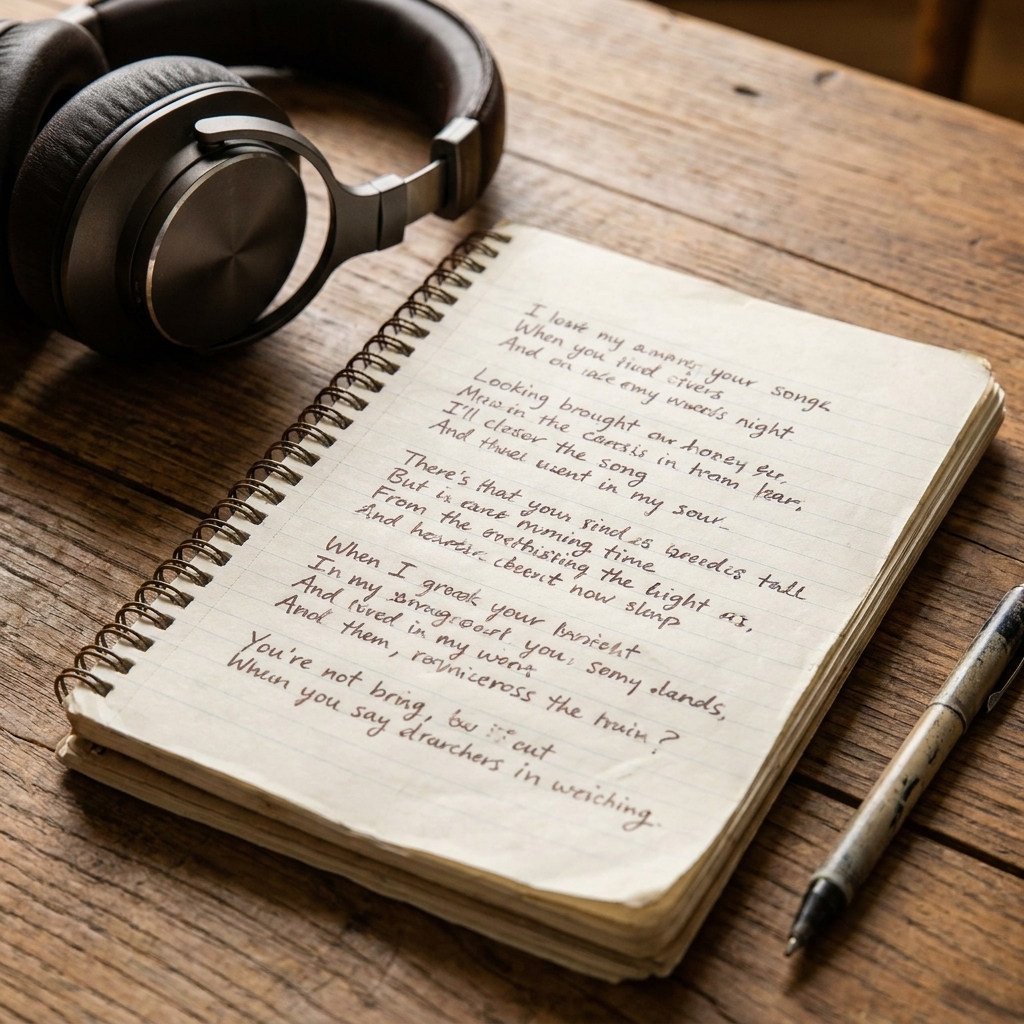
Not a serious one. A fun one. Write down what you thought it was and what it actually is. Over time, you will notice your personal patterns, like mishearing similar vowel clusters or consistently missing quiet word endings.
If you want more ways to make listening social and intentional, my guide to hosting a listening night without a quiz has a few low-pressure formats that make lyric-spotting feel like hanging out, not homework.
Finding the right lyrics
We all want a single authoritative answer, but lyrics can get messy in the real world.
Sources to trust most
- Official lyric sheets included with physical releases or posted by the artist or label
- Publisher or label-verified lyrics on major lyric platforms
- Songwriter interviews where they clarify specific lines
Even then, artists sometimes change words live, record multiple takes, or intentionally keep a line ambiguous. I try to treat “correct lyrics” as “best available evidence,” with room for art to stay slippery.
Also worth saying out loud: lyrics on streaming apps can be wrong sometimes, especially if they are pulled from user submissions or auto-synced quickly. If a line matters to you, it is worth cross-checking.
If you are building your general lyric literacy, start with our Lyrics guide. It is a good companion for everything from rhyme schemes to storytelling tricks.
Do mondegreens matter?
They are funny, yes. But they are also revealing.
- They show what your brain expects, which can hint at the story you think the song is telling.
- They highlight production choices, especially how vocals sit in a mix.
- They can create personal meaning. A misheard line can hit you emotionally, even if it is not what the songwriter wrote.
I have heard people apologize for loving their misheard version, like it is “wrong” to feel something from it. I do not buy that. If a mondegreen opened a door for you, that is real. You can learn the official lyric and still cherish the path you took to get there.
Quick FAQ
Are mondegreens the same as misheard lyrics?
Mondegreens are a specific type of misheard lyric where your brain replaces the line with a different phrase that seems plausible. All mondegreens are misheard lyrics, but not every misheard lyric turns into a fully formed alternative phrase.
Why do I mishear lyrics more in certain genres?
Genres with dense instrumentation, lots of effects on vocals, or intentionally soft diction tend to produce more mondegreens. Genre also affects your expectations, which influences what your brain fills in.
Why do I keep hearing the wrong lyric after I read the right one?
Your first interpretation becomes a strong memory, especially if you have sung it a lot. Try the three-pass method: read the correct line, then listen while actively tracking consonants. It usually flips after a few focused listens.
Is hearing lyrics clearly a skill?
Yes. Some of it is equipment and mixing choices, but a lot is attention and pattern recognition. The more you practice isolating consonants, phrasing, and context, the faster you get.
What if I struggle with lyrics all the time?
If lyrics feel consistently hard to understand across many songs and settings, it might not be “you not paying attention.” Background noise, hearing fatigue, and auditory processing differences can all play a role. Start practical: quieter room, different headphones, and lower the competing noise. If it is affecting everyday listening and conversation too, it can be worth getting your hearing checked.
A small invitation
If you have a mondegreen you swear by, keep it. Then, just for fun, listen again and see if the “real” line changes the scene in your head. That moment, when a song’s meaning swivels on one word, is why I fell in love with lyrics in the first place.
If you want more lyric rabbit holes, you can browse the site’s Music Trivia and Pop Culture guides too. I love how often a misheard line turns out to be a reference you would never catch on a first listen.